World Action Model
From skills
to new tasks
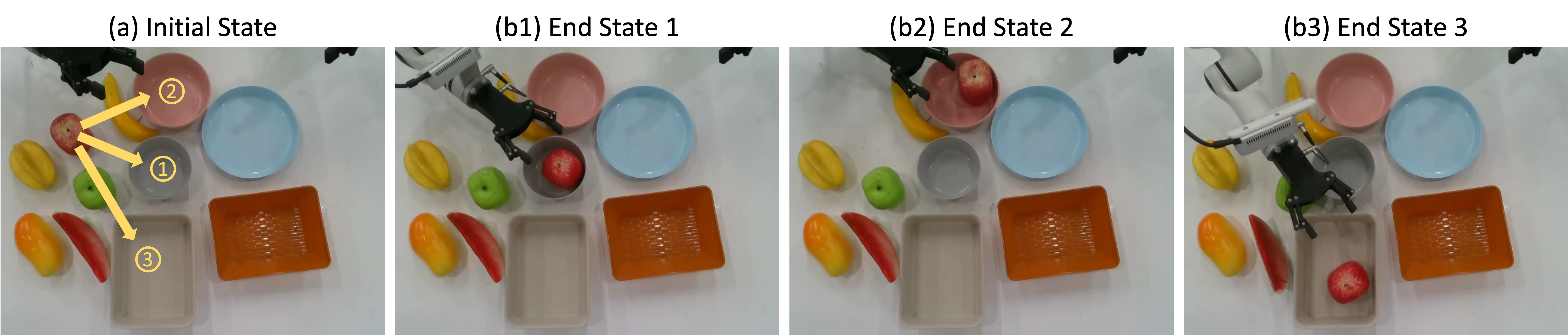
Grasping, turning and pulling can serve many tasks. We study reusable atomic skills and how to organize them around a goal and the current state of the world.
Atomic skill composition · Research concept
Conceptual example: organize skills around a target state and update observations after each step.
HyperNet · Method foundations
Networks that
generate networks
A hypernetwork produces the parameters of another network. This offers a way to generate representations or control policies from a condition, and informs our research into reusable action skills.
HyPoGen brings the structure of optimization into policy generation. The new HyperNet manuscript builds on this principle, using attention modules to scale to implicit representations of images, 3D shapes and NeRFs.
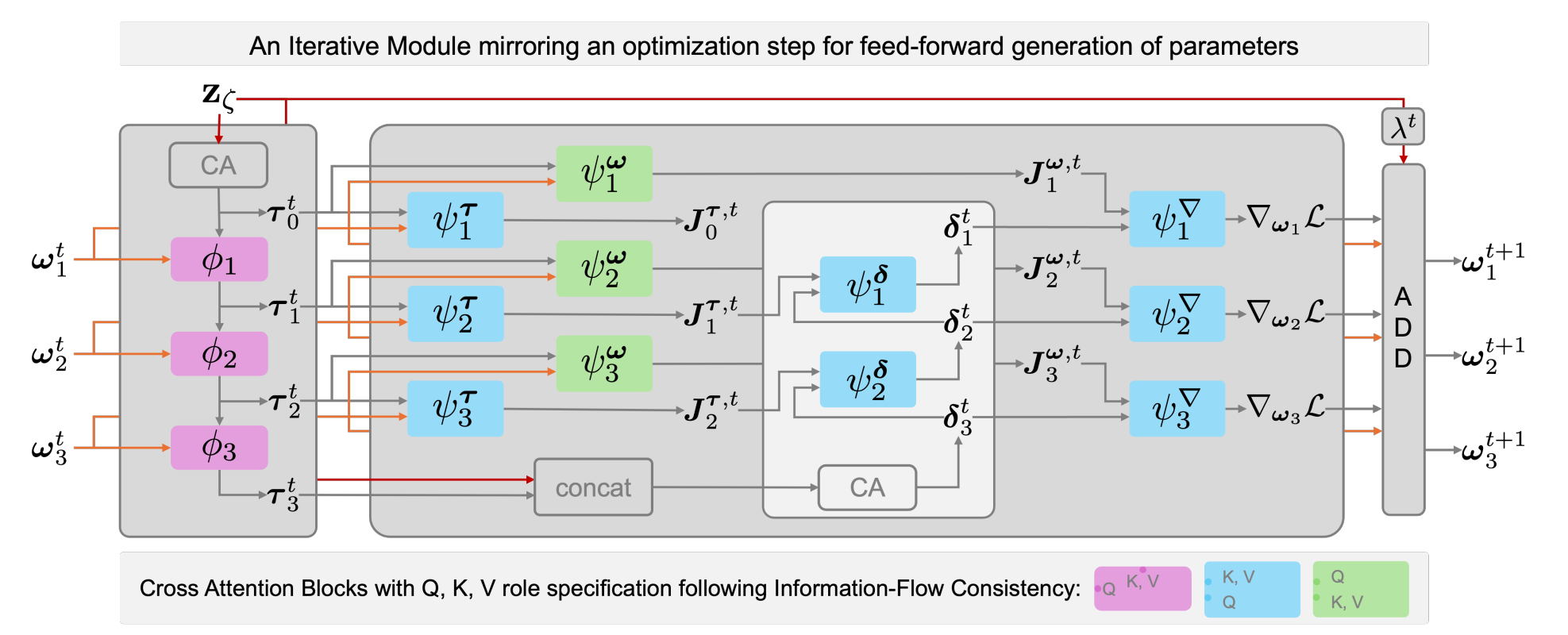
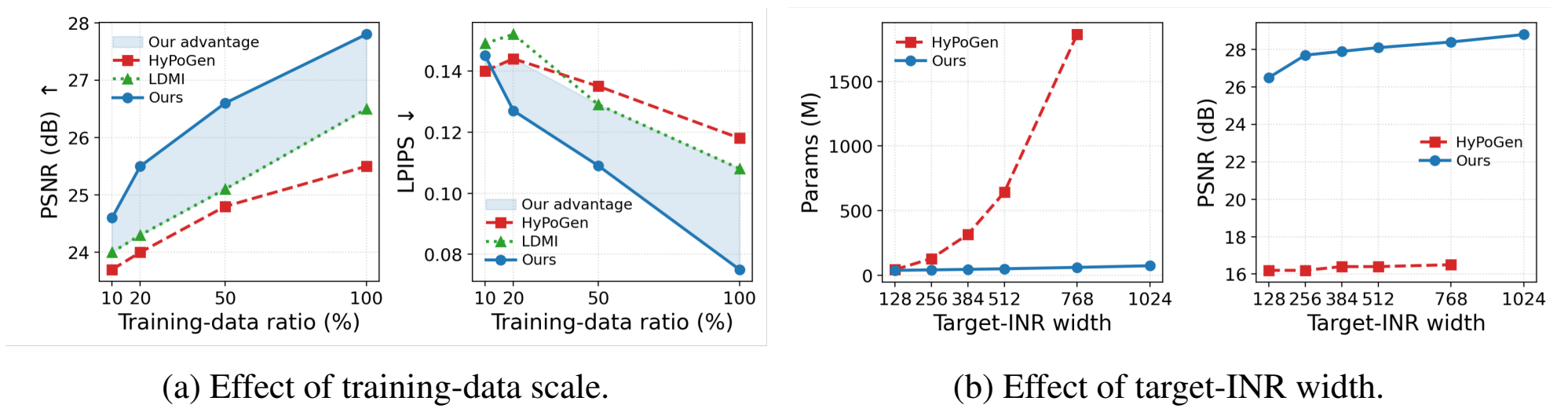
The manuscript tests 2D and 3D INR generation on five datasets. Skill composition is a research direction; robot experiments and generalization benchmarks test control and transfer separately.
Scaling Optimization-Oriented Hypernetworks for Implicit Neural Representations · Research manuscript
HyPoGen · ICLR 2025DISC · Control policies
A different goal.
A generated policy.
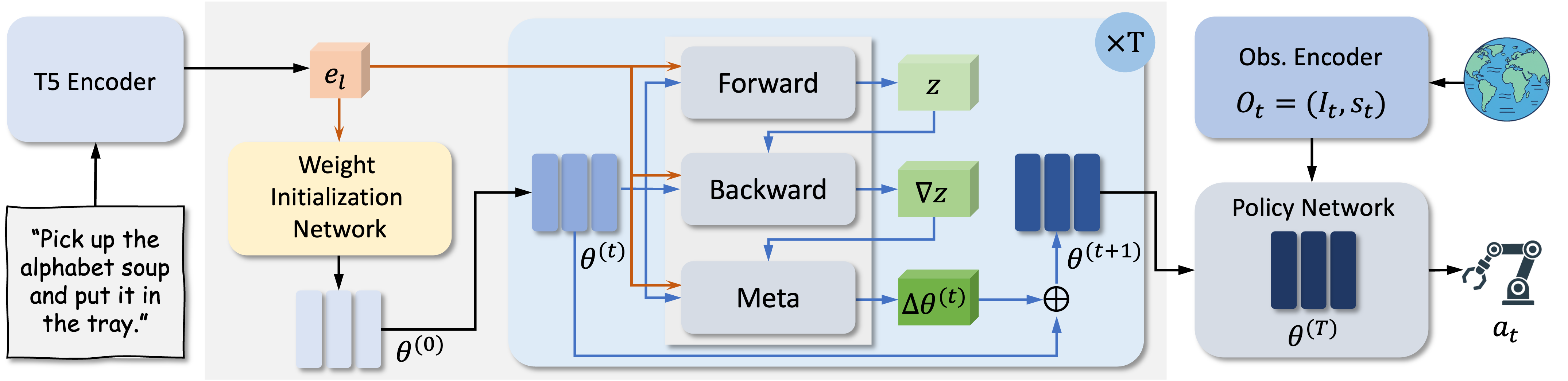
DISC generates a task-specific policy from a language instruction. During execution, the policy reads visual observations and robot state to produce control actions.
With about 30 million trainable parameters, DISC achieves results close to π₀.₅ in the reported LIBERO experiments.
Success rates, parameter counts and experimental conditions
The counts use different scopes. DISC’s 30M counts trainable parameters, excluding the frozen T5-small language encoder; its ResNet-18 visual encoder is fine-tuned. π₀.₅’s approximately 3.3B counts total model parameters.
Spatial / Object / Goal results use joint training, with 50 evaluations per task. π₀.₅ is fine-tuned from its pretrained checkpoint.
| Benchmark | DISC | π₀.₅ |
|---|---|---|
| LIBERO Spatial / Object / Goal (overall success rate) | 98.7% | 98.3% |
| LIBERO-90 | 94.3% | 95.7% |
View the DISC architecture
The Imitator Game · Generalization evaluation
Make generalization
testable
Xunzhe Zhou and collaborators introduce four levels of human-video imitation. Each increases the difference between a demonstration and the robot’s scene, testing whether the same goal can be achieved under new conditions.
The same goal can require different actions
We make the scope of generalization explicit: changes in position, appearance and function. The Imitator Game supplies graded tasks, paired demonstrations and evaluation protocols for comparisons under defined conditions.
Watch the full project overview2:51
Videos and figures are reproduced from The Imitator Game official project, with their original content preserved. The Imitator Game ↗ · MIT
Understand the world.
Learn how to act in it.
Talk with us about action learning, data collection or generalization evaluation. We welcome new research questions and shared experiments.